A good label is a handshake. It tells the shopper who you are before they taste a thing. For Canadian agri-food brands, that handshake happens in two languages. Most required label information must appear in both English and French, and the French needs to sound Canadian.
At JR Language Translation Services Canada, we provide agriculture translation services that keep all your target languages accurate, clear, and consistent.
What Has to Appear in Both Languages?
Canada’s agri-food, fish, and seafood exports recently reached nearly $100 billion. Plenty of that starts as a product on a shelf here at home. Every package carries words. To label the words with care – to be effective for your consumers – you need to seek out professional language solutions.
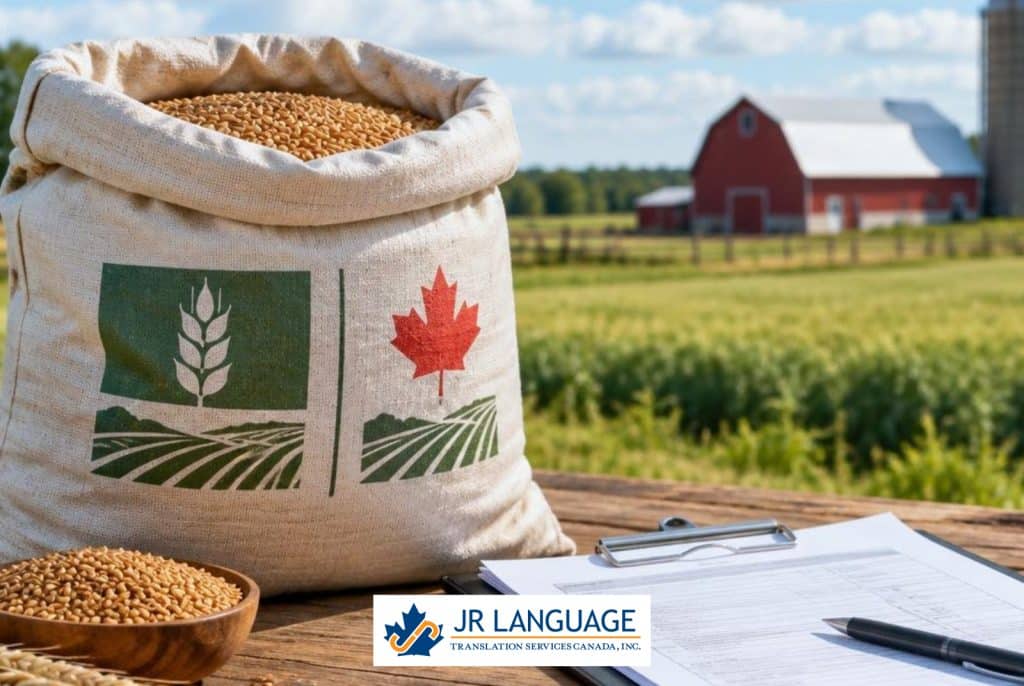
Most mandatory label information needs both English and French. That includes the product name, ingredient list, allergen statement, and Nutrition Facts table. Some details, such as certain business addresses, allow flexibility. Check the Canadian Food Inspection Agency’s rules for your product type before you finalize anything.
- Product name and common name
- Ingredient list, in the right order, in both languages
- Allergen statements, like “Contains: milk” and “Contient: lait”
- Nutrition Facts table, titled in both languages
- Best-before dates and storage instructions
- Front-of-package nutrition symbols
- Net quantity, with units that match
Why Does Canadian French Matter on Pack?
French can read as foreign to shoppers in Alberta, Quebec, or British Columbia if European conventions are used instead of Canadian ones. Food words differ. Blueberries, for example, are bleuets in Quebec, not myrtilles. Cranberries are canneberges. A label written for France may be understood, but it won’t feel local without Canadian French translation services.
- Vocabulary shifts from region to region, and food terms shift the most
- Numbers follow French conventions: “1,5 kg” with a decimal comma, not “1.5 kg”
- Punctuation spacing differs, too. Canadian French puts a space before a colon
- Quebec has its own French-language rules for packaging, so confirm requirements before printing
- A native Canadian French reviewer should sign off on the final text
How Do You Keep the Layout from Breaking?
French usually runs longer than English. Plan for it early.
- Leave room. The translation won’t fit the English space
- Pick a layout up front: side by side, stacked, or separate panels
- Send editable design files. Locked PDFs slow everything down
- Keep type legible in both languages. Don’t shrink the French to make it fit
- Check the proof in both languages at the final print size
Where Do Bilingual Labels Usually Go Wrong?
Mistranslation happens rarely in big things. You usually find them in the smaller documents, where you may not have worked with an expert.
Without professional marketing translation services, for example:
- Claims like “farm fresh” may get translated word-for-word and can sound odd in French
- Ingredient names may not match between English and French
- Allergen statements may disagree with the ingredient list
- Old French text may get left on a reformulated product
- Units and numbers may be written in the English way on the French side
What Happens Before Your Labels Go to Print?
A few steps catch most problems early. We build them into every label project.
- We start with a glossary of ingredient and product terms, so wording stays consistent across every product line
- Lock the English text first. Late changes cost time and money
- A translator with food and agriculture knowledge handles the draft, and a second linguist reviews it
- A last read on the print-ready proof catches the small stuff: missing accents, broken line breaks
- We keep a translation memory, so your next label matches your last one
Do Labels Need More Than Translation?
Often, yes. The label is just the start. The same terms should show up on spec sheets, retailer portals, and your website. When a label says one thing and a product page says another, buyers ask questions. Matching wording across the board keeps your brand steady and your approvals smoother. We keep the terminology aligned from the first label to the last page.
Get Your Labels Ready with Professional Agricultural Translation Services
Which products are launching? Which markets? Start there. We’ll sort the label content, the languages, and the review steps.
Looking for agriculture translation services that know the Canadian shelf? Reach out to our translation agency before your next print run. We’ll shape the plan around your timeline.


