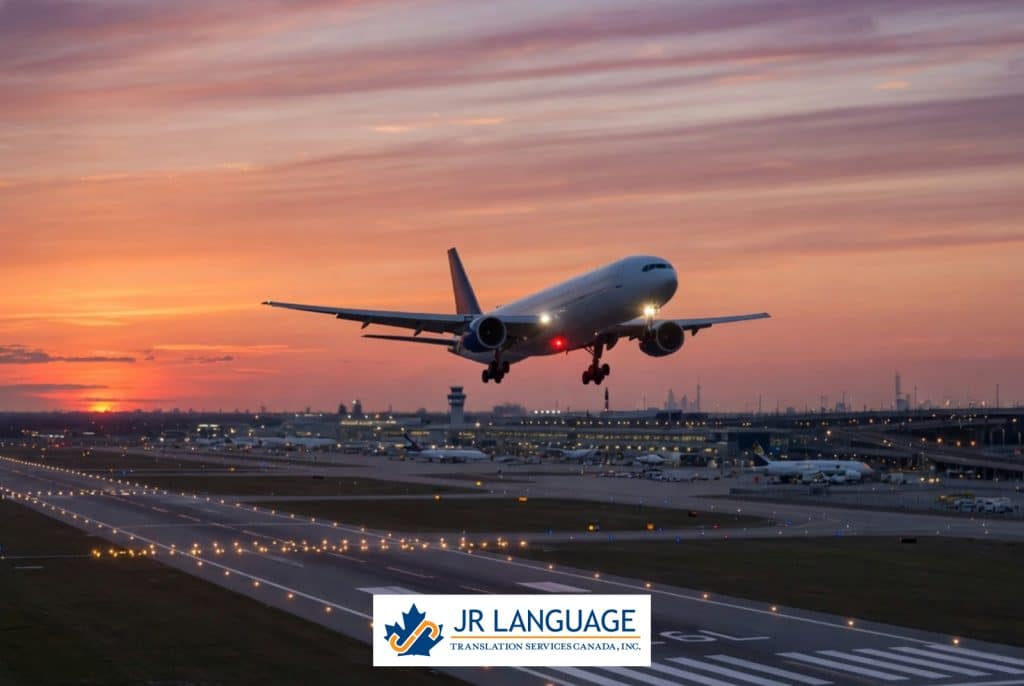
Canada’s aerospace sector is a global powerhouse, contributing $34.2 billion to its GDP in recent years. It also exports nearly $27 billion in goods to 166 countries worldwide. Moreover, its supply chains, partnerships, and regulations span continents and languages. As a result, the country’s aviation industry is part of a large international operational framework.
Such a worldwide reach generates an enormous amount of multilingual documentation – and that’s where professional language translation services come in. In aerospace, the margin for error when it comes to language is just as tiny as the margin for error in engineering: Zero. With JR Language Translation Services Canada, you keep things accurate, compliant, and safe. This applies to maintenance manuals and engineering specs as well as regulatory filings and supplier contracts.
Aerospace Translation Is a Specialized Field
The world of aerospace translation services is extremely critical. The terminology is dense, and the regulatory stakes are incredibly high. A single mistranslated phrase in a technical document can have consequences that go way beyond a simple communication breakdown.
Aviation translation is quite complex among the technical document translations –
- Documentations span multiple disciplines: physics, materials science, avionics, structural engineering, and regulatory law often appear on the same page
- Acronyms carry precise, context-dependent meanings that vary from one subsector to another (for instance, what “fuel cell” means in satellite systems is completely different from what it means in ground support equipment)
- Documentation must meet the standards of multiple international regulatory bodies, not just one
- Errors in safety-critical documents carry risks of direct operational and human consequences – across maintenance manuals, emergency checklists, and warning labels
- Multilingual consistency must be maintained across thousands of pages and years of documentation updates
That’s why aerospace translation requires linguists with a deep understanding of the subject matter, not just fluency in the target language. At JR Language Canada, we work with industry experts in this field for our aviation-related document translation services.
The Regulatory Landscape: Compliance in Multiple Languages
International Oversight Bodies
Canadian aerospace companies working globally have to navigate a complex web of regulatory authorities. The documentation must be right for multiple different authorities at once:
- Transport Canada Civil Aviation (TCCA) – the home regulatory authority for airworthiness, certification, and maintenance standards in Canada
- International Civil Aviation Organization (ICAO) – sets global standards for civil aviation safety, security, and environmental protection
- European Union Aviation Safety Agency (EASA) – critical for any operations or certifications involving European markets
- Federal Aviation Administration (FAA) – essential for companies that are tied into North American supply chains or selling into the US market
Each of these bodies has its own rules about terminology, documentation format, and language use. If you get it wrong – even if it’s technically accurate but just formatted or worded incorrectly – you’re looking at rejected filings, delayed certifications, and grounded operations.
Export Control and Defence Considerations
Aerospace companies working in the defence sector have to worry about export control frameworks on top of all that. Additionally, sensitive technical documentation has to be handled with absolute care – encrypted file transfer, restricted access, and non-disclosure agreements that can stand up to international scrutiny. The right translation partner, one that specializes in defence-related aerospace content, understands these rules. Furthermore, it has documented processes for adhering to them.
Key Documents That Need Aerospace Translation Services
The volume and variety of documentation across an aircraft or spacecraft’s lifecycle is just massive. Every stage – from R&D through translated documents for manufacturing, operations, maintenance, and decommissioning – generates technical content. This content has to be accurately rendered for international audiences.
Aerospace translation and localization will ensure your cultural adaptation, unit conversions, regulatory references & interface terminology all meet the standards of the target market. Not just the source document.
Technical Manuals
The most critical category of aerospace documentation is:
- Aircraft Maintenance Manuals (AMM)
- Component Maintenance Manuals (CMM)
- Illustrated Parts Catalogs (IPC)
- Structural Repair Manuals (SRM)
- Flight Operations Manuals
Many aerospace organizations use the S1000D international standard for technical publications – an XML-based system for managing information across complex documentation systems. What that means is you need a multilingual DTP translation partner who can work directly within these XML schemas. This ensures the translated content fits right back into your Content Management System (CMS). It does so without breaking formatting, cross-references, or data architecture.
Regulatory and Compliance Documentation
- Airworthiness certification filings for TCCA, EASA, and FAA
- Safety Data Sheets and hazardous materials documentation
- Environmental compliance reports
- Quality management documentation under ISO 9001 and AS9100 standards
Legal and Commercial Documentation
- International patent applications and IP protection filings
- Multi-jurisdictional procurement and supply chain contracts
- Joint venture and partnership agreements
- Non-disclosure agreements and licensing contracts
Getting these documents right – both technically accurate and legally binding in the target jurisdiction – requires legal translators who understand aerospace law and commercial practice. They also need to understand not just the language.
Training and eLearning
Global aerospace operations require consistent, high-quality training across all locations and languages. A technician in Montreal and a maintenance crew in Kuala Lumpur need to work from the same standards and understand them just as well.
eLearning translation services that encompass training content for the aviation industry include:
- Interactive eLearning modules and training software, including SCORM-compliant content
- Safety handbooks and emergency procedures
- Instructional video translations – subtitling, dubbing, and voiceover in target languages
- Flight simulator user interfaces
- Onboarding materials for multinational engineering and maintenance teams
Building the Foundation for Consistency: Terminology Management
One of the biggest dangers in long-term aerospace translation projects is inconsistency. When a technical term is translated differently across documents or update cycles, it can lead to confusion. It can cause compliance failures and worse.
Aerospace translation services address this problem by:
- Client-specific glossaries – a controlled vocabulary of approved translations for all the key terms, acronyms & product names that are specific to the organization
- Translation memory – a secure database that stores previously approved translations so you can be sure identical terminology is used every time a particular phrase appears across thousands of pages
- Quality control workflows – multi-step review processes that include subject-matter expert review alongside linguistic review, to catch any errors that a language check alone might miss
These tools not only reduce costs and turnaround times for ongoing documentation updates but also provide a significant advantage for organizations that have to manage large volumes of technical content across multiple languages.
Getting Your Documentation Moving at the Speed of Global Aerospace
Canada’s aerospace industry is a global player – and the documentation that supports it has to keep pace. Whether you’re managing multilingual maintenance manuals, pursuing certification in a new market, localizing training content for an international workforce, or protecting IP through cross-border contracts, the quality of your translation directly impacts your operational outcomes.
We work with aerospace and defence organizations to deliver precise, secure & technically accurate translation services. Our team provides the subject-matter expertise and terminology management tools that your documentation needs.
Contact us today to talk about your next aviation translation project – we are happy to help!