Section 14 of the Canadian Charter of Rights and Freedoms is unambiguous:
Any party or witness in a proceeding who does not understand or speak the language being used has the right to the assistance of an interpreter.
That right extends to any proceeding in which language access determines whether a person can meaningfully participate. This includes:
- courts
- tribunals
- administrative hearings
Why Public Organizations Must Bridge the Language Gap
What the Charter establishes as a right, public institutions are responsible for delivering.
And the population that depends on professional translation services and interpretation options is substantial. Nearly three in ten people in this country converse in a non-official language. Almost 700,000 are unable to speak either English or French.
Linguistic diversity is even more pronounced in major urban centres such as:
- Toronto
- Vancouver
- Montreal
- Calgary
Government Interpreting: The Language Infrastructure Behind Public Service Delivery
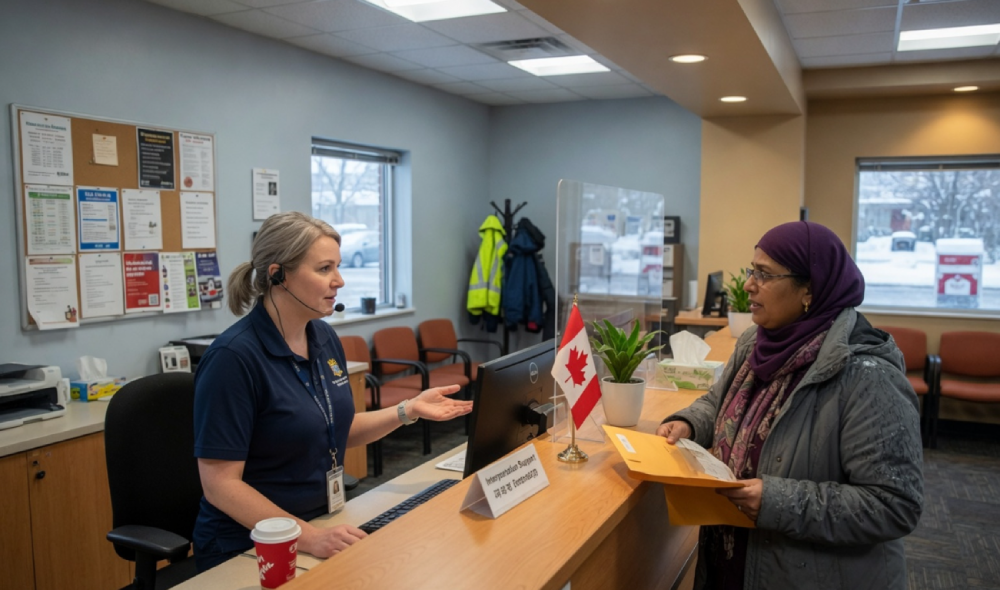
Government agencies, courts, health authorities, and public service providers are interacting with this population every day.
Professional government interpreting services are the infrastructure that enables those interactions. When that infrastructure is strong, institutions fulfill their obligations. When it isn’t, the consequences show up in:
- legal proceedings
- health outcomes
- public trust
- and more!
What Government Interpretation Services Cover – and Why It Matters
Interpretation services for government span three broad categories of institutional need. Each carries its own communication requirements, compliance obligations, and standards for what a qualified interpreter must bring to the setting.
Business and Administrative Interpretation
Government operations involve a constant volume of multilingual communication:
- interagency meetings
- policy consultations
- international delegations
- public service interactions
- workforce training
For departments and agencies that manage diverse populations or operate across jurisdictions, government translation services and interpreting solutions are recurring functions.
Business and administrative interpretation in government settings includes:
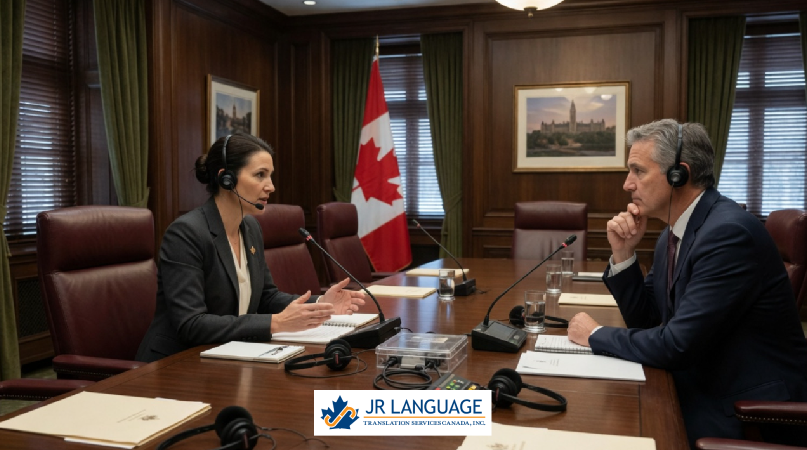
- Intergovernmental meetings and international policy discussions: Simultaneous interpretation supports high-level dialogue without disrupting the flow of proceedings
- Public service interactions: Residents who don’t speak English or French can access the services they’re entitled to, from municipal offices to federal agencies
- Workforce training and internal communications: Policies and safety information need to reach every employee clearly in departments with linguistically diverse staff
- Community engagement events: Conference interpretation is essential for town halls, consultations, and public meetings – participation depends on language access
The standard for interpreters in these settings goes beyond language fluency. Government terminology is specific, procedures are formal, and the stakes of a miscommunication — a misunderstood policy, a misrepresented commitment — are institutional.
Legal and Judicial Interpretation
The legal and judicial sector has the most clearly defined interpretation obligations of any government context. Section 14 of the Charter applies directly here, and the consequences of a language gap in a legal proceeding are constitutional.
Legal interpretation services cover a wide range of proceedings and settings:
- Courtroom proceedings: Ensures all parties understand what is being said, and that their statements are rendered accurately into the language of the court
- Depositions, hearings, and administrative tribunals: Includes immigration hearings, refugee claims, labour board proceedings, and human rights tribunal matters. The interpreter’s role is to facilitate complete and accurate participation
- Law enforcement interactions: On-site, video, and/or phone interpreting for multilingual witnesses, victims, and individuals in contact with police, where precision in real time directly affects the integrity of an investigation or proceeding
Legal interpreters must meet a specific standard of performance: continuous, precise, impartial, and competent. They render the exact meaning of what is said without summarizing, editorializing, or filtering. In this setting, the interpreter is not a communication facilitator. They are a constitutional requirement.
Public and Community Interpretation
Beyond formal government operations and legal proceedings, interpretation services support the public-facing work that institutions do in communities every day.
This is where language access has the most direct impact on health equity, social inclusion, and the lived experience of residents navigating government systems.
Public and community interpretation includes:
- Healthcare and public health settings: Hospitals, community health centres, public health authorities, and social service offices where patients need to communicate clearly with providers and understand the care they’re receiving
- Elections and civic participation: Polling stations, candidate meetings, and public consultations where democratic participation depends on accessibility
- Community outreach and social services: Settlement services, housing authorities, employment programs, and other public services accessed by newcomers and multilingual residents
Research on language access in healthcare settings is consistent and well-documented. Studies published in peer-reviewed literature show that patients with language barriers who receive professional interpretation experience:
- better clinical outcomes
- shorter hospital stays
- lower readmission rates
The Canada Health Act principle of accessibility implicitly requires that language not be a barrier to health services. Professional interpretation is how that principle is met in practice.
Who Qualifies to be a Government Interpreter
Not every bilingual professional is equipped for government interpretation work. The standards in this field are specific, and for good reason.
A qualified government interpreter brings:
- Subject matter knowledge: familiarity with the terminology of the relevant domain, whether that’s legal procedure, healthcare, administrative law, or public policy. Language fluency without domain knowledge produces a technically correct interpretation that misses the legal or procedural meaning of what was said
- Impartiality and professional ethics: interpreters in government settings must be neutral parties, with no stake in the outcome of a proceeding, and governed by confidentiality obligations that reflect the sensitivity of the information they handle
- Precision under pressure: particularly in simultaneous interpretation, the cognitive demands of the work are significant. Government interpreters are trained to maintain accuracy and consistency across the length of a proceeding without filtering or summarizing
- Security and confidentiality compliance: government interactions often involve sensitive personal information, classified materials, or legally privileged communication. Interpreters and the organizations that place them must meet appropriate security standards
JR Language Canada: Fulfilling the Right to Language Access
At JR Language Translation Services Canada, our government interpreting services cover the full range of public sector needs:
- business and administrative interpretation
- legal and judicial settings
- public and community services
We work in both official languages, offering English and French interpretation services for all industries. We also deliver translation and interpreting services for Indigenous languages and the immigrant languages most prevalent in communities across the country.
Our interpreters bring domain expertise alongside language fluency. We understand the confidentiality, accuracy, and compliance standards that government work demands.
Does your institution need interpretation services that meet the Charter’s standards and the expectations of the communities you serve? Consult with us today – we are happy to help!