The combined value of goods and services traded across our borders exceeds $1.5 trillion, according to Statistics Canada. Behind every contract and client relationship in that number is documentation.
Add to that a domestic workforce that speaks dozens of languages beyond English and French. The scope of the language challenge facing businesses today becomes clear.
You need to communicate accurately in more than one language. The question isn’t whether translation services are needed. It’s whether the right ones are in place. These must be matched to:
- right industries
- document types
- languages
Professional translation services aren’t a niche requirement. For any business operating at scale, they’re a core function.

What Professional Translation Services Cover
| JR Language Canada Options | Best For | Key Strength |
|---|---|---|
| Full-service agency | Legal, medical, business | Domain expertise |
| Online translation services | High volume, fast turnaround | Speed + API integration |
| Technical expertise | Compliance/regulations | Government/court acceptance |
| Localization services | Websites, apps, marketing | Cultural adaptation + SEO |
| AI-assisted hybrid | Enterprise scale | Cost efficiency + human review |
Multilingual translation services cover a wide range of work. At the foundational level, it means converting written content accurately from one language to another.
But professional translation services extend well beyond that into:
- Localization services
- Transcreation services
- Interpretation services
- Technical specialization
Each serves a different communication need.
Written Translation vs. Interpretation
These are two distinct disciplines that are often grouped together but require different expertise.
Written translation handles documents, websites, and content. It’s an asynchronous process. The priority is precision, consistency, and suitability for the target market.
Translators need to:
- research terminology,
- verify accuracy, and
- produce a polished final text.
Interpretation handles spoken communication in real time. Interpreters bridge language gaps during live conversations:
- business negotiations
- legal proceedings
- medical consultations
- training sessions
- conferences
The skill set is different. Interpreters need to provide:
- instant comprehension
- cultural fluency
- convey tone
- the ability to register under pressure
For businesses managing cross-border relationships or multilingual workforces, both are typically needed. They come in handy at different moments and for different purposes.
Localization and Transcreation
Not all translation is equal, and the distinction matters more as content becomes more customer-facing.
Localization adapts content for a specific regional and cultural context. It accounts for:
- dialect
- idiom
- tone
- formatting conventions
- cultural reference
A document that is linguistically accurate but culturally off-key will underperform with its intended audience.
Transcreation goes further still. Used primarily for marketing and brand content, it involves rebuilding the emotional architecture of a message in a new language. This preserves the intent and impact of the original:
- tagline
- campaign headline
- brand narrative
These often can’t be translated directly. The message has to be recreated.
Industries That Rely on Professional Translation Services
The need for professional translation services is concentrated in industries where accuracy is non-negotiable. The regulatory stakes could be high, the liability exposure could be real, or both.
Legal and Professional Services
Legal translation is among the most demanding categories in the field. This covers:
- contracts
- commercial agreements
- NDAs
- corporate governance documents
- patent filings
- court materials
These require translators who understand not just the language but the legal framework of the target jurisdiction.
The challenge here is twofold:
- First, legal terminology is precise and jurisdiction-specific. Concepts that have settled meaning in common law may not have direct equivalents in civil law systems, and vice versa.
- Second, any ambiguity introduced in translation becomes a potential liability. For businesses operating across provincial or international lines, professional legal translation services are part of the risk management framework.
Healthcare and Life Sciences
In healthcare, translation errors have direct consequences for patient safety and regulatory compliance. Document translation services in this sector cover:
- Clinical trial documentation and informed consent materials
- Medical device manuals and technical instructions
- Healthcare provider communications and patient-facing materials
- Regulatory submissions and compliance filings
Translators working in this space need subject-matter expertise:
- medical and pharmaceutical terminology
- regulatory standards
- jurisdiction-specific requirements
Linguistic skill alone is not sufficient.
Financial Services and Banking
Financial translation requires precision in a context where ambiguity carries legal and regulatory risk. The range of documents is broad:
- Regulatory filings and compliance documentation
- Investor communications, prospectuses, and annual reports
- Banking product documentation and terms of service
- Marketing materials for financial products in regulated markets
Financial services are heavily regulated at both the federal and provincial levels. Documentation presented to regulators or distributed to consumers must meet accuracy standards that generic translation cannot reliably achieve.
Manufacturing and Energy
For manufacturers and energy companies operating across markets, translation services support the full production and compliance lifecycle:
- Safety manuals and WHMIS-compliant documentation
- Technical manuals, engineering specifications, and SOPs
- Training materials for multilingual workforces
- ESG reports and sustainability communications for international stakeholders
- Export compliance documentation for destination markets
In this sector, the cost of a translation error in a safety document or technical specification goes beyond communication quality. It is measured in terms of liability exposure and workplace risk.
Human Resources and Corporate Operations
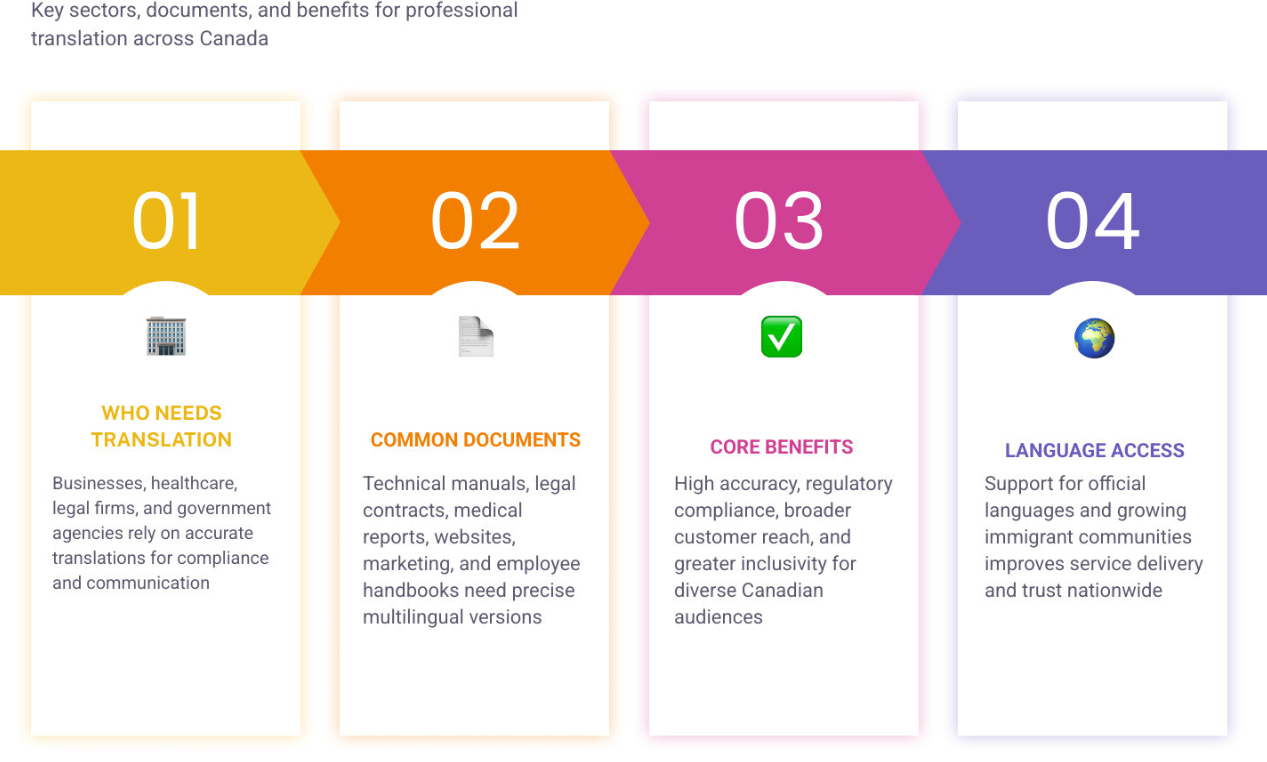
Across industries, HR and operations teams manage translation needs that are often underestimated in scope. For a multilingual workforce, all these must be accessible to everyone in the team:
- employee handbooks
- employment contracts
- workplace policies
- onboarding materials
- training content
In industries with large proportions of workers whose first language isn’t English or French, this isn’t a courtesy. It is a compliance and retention issue.
Commonly Asked Questions About Translation Services
What is the difference between translation and interpretation?
Translation handles written content: documents, websites, reports, and marketing materials. Interpretation handles spoken communication in real time, such as business meetings, legal proceedings, and training sessions. Both require professional expertise, but they are distinct disciplines with different skill sets.
Which industries rely on professional translation services the most?
Legal, healthcare, financial services, manufacturing, and HR-intensive industries have the highest and most consistent translation needs. These are sectors where document accuracy has direct compliance, safety, or liability implications. A single error in a translated document carries real consequences.
What languages are most in demand for translation services in Canada?
Canadian French translation services are the baseline requirement for any business operating nationally or targeting Quebec. Beyond the official languages, the highest-demand languages reflect the makeup of the workforce and major urban populations: Punjabi, Mandarin, Arabic, Tagalog, Spanish, Hindi, and Farsi are among the most frequently requested. Indigenous Language Translations are also often sought after.
How do I choose the right translation services provider for my organization?
The most important factors: industry expertise, native-speaker fluency in the specific regional variety you need, a multi-step quality assurance process, and familiarity with the compliance requirements in your jurisdiction. A professional provider such as JR Language Translation Services Canada can handle your full document set, rather than only certain content types. This ensures consistency across all your materials.
JR Language Canada: Translation Services That Work Across Every Language You Need
At JR Language Translation Services Canada, our language services cover the full scope of what businesses in regulated and complex industries require:
- document translation
- legal translations
- technical content
- marketing localization
- HR documentation
- interpretation services
We work in over 100 languages. We work with native-speaking translators who bring both language fluency and subject matter expertise. We understand the compliance requirements that apply across federal and provincial jurisdictions.
Does your business need translation services that meet regulatory scrutiny? Are you seeking to communicate effectively with every audience you serve? Consult with us today! We’d welcome the conversation.


