The mining workforce is multilingual, spread across the country, and working in some of the most hazardous workplaces on the planet. Employment in this sector has grown significantly, with last year seeing a record of over 100,000 workers. The minerals industry is also one of the largest employers of Indigenous peoples. Immigrants, temporary foreign workers, and contractors are also constantly rotating through remote sites.
All these factors make language access with mining translation services more than an administrative checklist item. It is vital for the safety of your workers. In most places, it is also legally required. Seeking to provide workforce safety documents to a diverse workforce? Looking to ensure Indigenous communities are on board? Partnering with a professional language translation company on and around mine sites helps you achieve your goals.
Why Language Gaps on Mine Sites Carry Real Risk
A worker who cannot fully read a safety procedure, a warning label, or an emergency response guide is operating with incomplete information. In mining, hazards include explosives, heavy machinery, toxic gases, confined spaces, and extreme terrain — any miscommunication becomes dangerous.
Mining multilingual translation services cover:
- Standard Operating Procedures for running and maintaining equipment
- WHMIS Safety Data Sheets and hazardous materials labels – required in both English versions and French translations under federal regulation, and often needed in additional languages
- Emergency response procedures, evacuation plans, and lockout/tagout protocols
- Guides for using personal protective equipment and fit-testing instructions
- Incident reporting forms and near-miss documentation
- Environmental monitoring protocols for on-site crews
- Equipment manuals and technical maintenance guides for heavy machinery
Each of these documents is a lifeline for communication between an employer and a worker in a high-risk workplace. If the document exists only in a language the worker can’t read, the employer is on the hook, and the employee takes a huge risk.
Modern Mine Sites and Tech Documentation
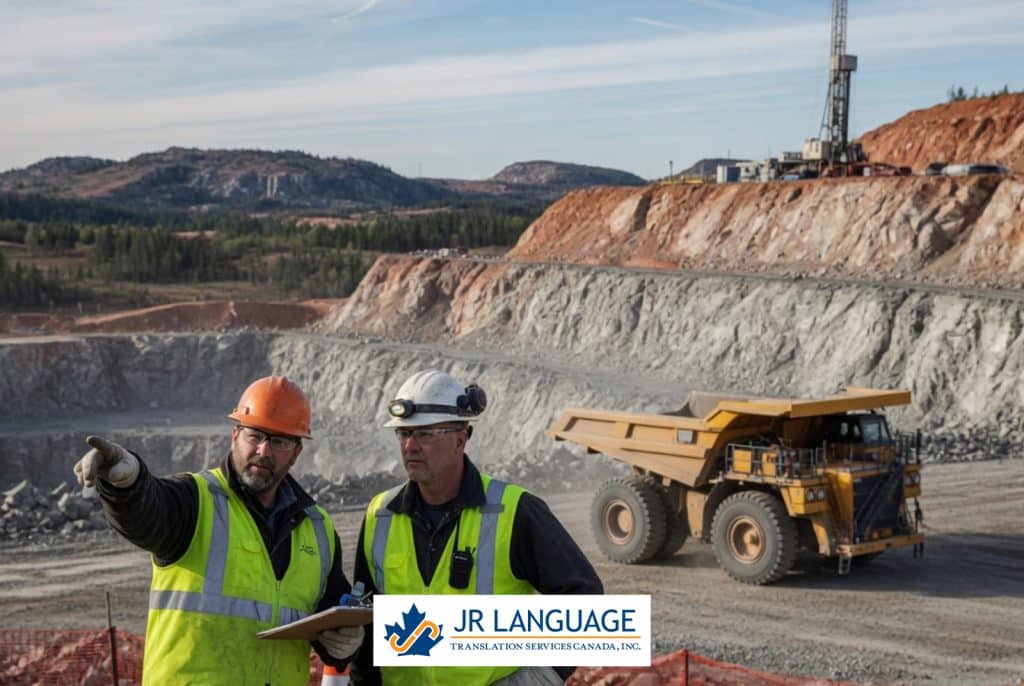
Sophisticated mining operations rely on high-end equipment, digital platforms, and automated monitoring systems that generate unique translation requirements.
Specialist translation is needed for tech documentation that includes:
- Manuals for operating autonomous drilling, haulage, and processing equipment
- Software interfaces and digital alert systems for on-site machinery – a misread warning about hydraulic pressure, gas levels, or structural load can have immediate consequences
- Geological survey reports and core sampling documentation for technical teams
- Engineering specs for constructing the mine, managing tailings, and infrastructure
- Online training modules and onboarding content for remote workers
For mining translation, you need linguists with engineering or geoscience backgrounds – not some generalist working off a glossary. A translator without knowledge of mining will create text that reads okay to non-experts but would be a red flag for any engineer or safety officer.
Meeting Regulatory Compliance Across Multiple Jurisdictions
Mine sites operate under overlapping federal and provincial rules. Each requires that mining document translations be accurate, complete, and, if needed, available in more than one language.
Federal Rules and Regulations
At the federal level, WHMIS demands that all Safety Data Sheets and supplier labels for hazardous products be provided in both English and French. The Impact Assessment Act sets out rules for environmental assessments of major projects. Technical document translations must be made accessible to all parties involved in the review, including community stakeholders who may not speak English.
Provincial OHS Requirements
Each province has its own OHS legislation that sets out specific rules for worker communication, safety signage, and training documentation. In Quebec, the Charter of the French Language imposes additional obligations on French-language workplace communication at all levels. In Ontario, BC, and Alberta, OHS regulations say workers have to be told about hazards in a way they can understand – which, for multilingual workforces, means translation is not optional.
Environmental Assessments and Permits
Environmental impact assessments for major mining projects can run hundreds of pages and contain super technical language. If you mistranslate something in a regulatory submission, it can hold up project approvals for months. Permits, land use agreements, and environmental management plans all need to be translated accurately for submission to regulatory bodies – and for distribution to the communities and stakeholders who are gonna be affected by the project.
Indigenous Community Consultation: A Legal Reality and A Relationship Builder
The duty to consult Indigenous communities is codified in provincial mining legislation. Meaningful consultation under UNDRIP and the Truth and Reconciliation Commission means having documents, meeting materials, and project summaries that communities can engage with – which means documents that are available in the languages people actually speak – often their Indigenous language alongside English or French.
At JR Language Canada, our Indigenous language translation services help this process by enabling:
- Translation of project summaries, environmental assessments, and impact studies into relevant Indigenous languages
- Preparing community consultation materials – meeting notices, benefit agreement summaries, mitigation plans – in formats and languages that work for informed participation
- Translating free, prior, and informed consent documents into Indigenous languages when necessary, as required
- Providing interpretation services for meetings between mining companies, government reps, and First Nations communities
Companies that invest in culturally sensitive and linguistically accurate consultation communication are building the social licence that determines project viability over the long term. On the other hand, firms that treat translation as an afterthought during consultation risk delay, legal headaches, and damaged relationships that cost way more to fix.
Ready to Ensure Every Worker Stays Safe?
With workforce growth, complexity, and regulatory scrutiny, multilingual communication is more operationally critical than ever for mining. Whether you need safety documentation for a multilingual work crew, an environmental assessment, or consultation materials for a First Nations community, the quality of your communication really shapes the outcome of your project.
JR Language Translation Services Canada works with mining operators, engineering firms, and project proponents to deliver accurate, high-quality language solutions – including Indigenous Language translation and interpretation services for consultation processes – across every stage of the mine life cycle. We’d be happy to discuss what your project needs.