What is the most expensive mistake in a manufacturing export? It isn’t the product. Neither is it the logistics nor the regulatory filing fee.
It is a single mistranslated line in a safety document. The one that clears internal review because no one on the team reads the target language. It has already shipped with the product. It is now only surfacing because something has gone wrong on the floor.
At this point, the cost isn’t what you saved with the free translation tool. It’s the liability, the recall, the enforcement action – or worse.
Professional Translation Services are a Risk Management Decision
Seeking manufacturing documents in multiple languages? You need to work with professional translation services. With industry experts, you get regulatory compliance, technical accuracy, and operational continuity.
Do not treat manufacturing translation services as an afterthought? You may find out, at the worst possible moment, that it wasn’t.
Canada’s Export-Driven Manufacturing Sector
The scale of manufacturing’s global reach is huge:
- Manufacturing accounts for 52.6% of Canada’s total goods exports.
- Canadian manufacturers sell approximately half of their products to foreign customers.
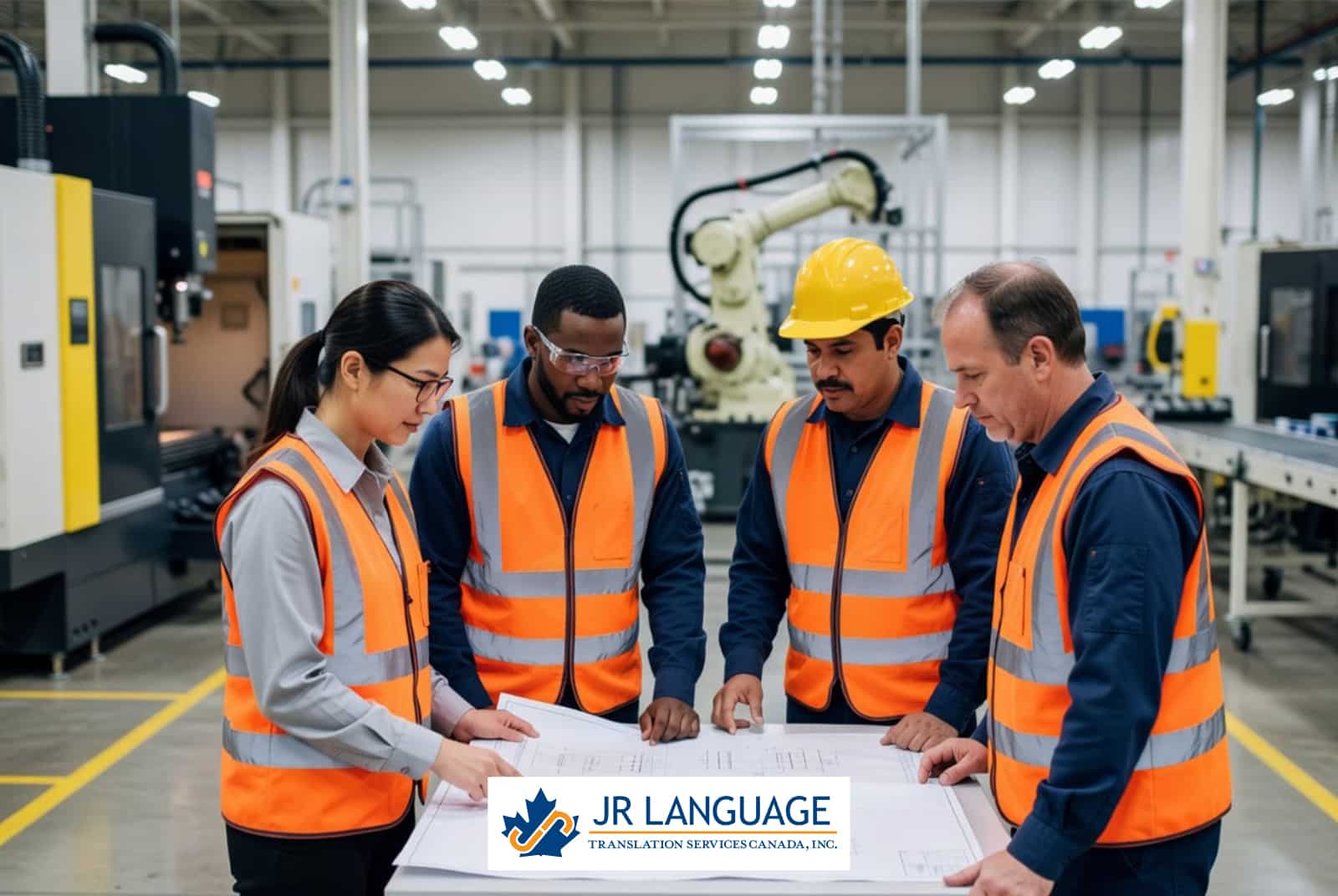
That is a huge volume of cross-border trade. This means a significant share of your manufactured output is arriving in workplaces, assembly lines, and end-user environments across diverse markets. English isn’t always the working language.
The Need for Multilingual Services
That creates a need for document translation services that run deeper than marketing copy. Is your product entering a new market? It brings along all the paperwork attached to it.
You need to translate technical manuals, safety data sheets, operating instructions, compliance certifications, and e-learning training materials.
What Manufacturing Translation Services Cover
The scope of translation in the manufacturing sector is broader than most teams initially account for. It spans the full lifecycle of a product. These range from pre-production documentation through to end-user communication.
Here’s what technical translation services for manufacturing typically cover:
- Safety Data Sheets (SDSs) and WHMIS documentation: bilingual compliance under the Hazardous Products Act, including all 16 prescribed sections in both English and French
- Technical manuals and user guides: operating instructions, assembly guides, maintenance procedures, and troubleshooting documentation that workers and end-users rely on daily
- Standard Operating Procedures (SOPs): internal process documentation that needs to be accurate and consistent across multilingual facilities or distributed teams
- Engineering specifications and schematics: technical drawings, tolerances, and specifications that require translators who understand the subject matter, not just the language
- Regulatory and compliance filings: documentation required for export markets, including product certifications, conformity declarations, and market-specific regulatory submissions
- Training materials and e-learning content: onboarding modules, workplace safety training, and skills development content adapted for multilingual workforces
- Marketing and commercial content: product descriptions, procurement documentation, and sales materials for international buyers and distributors
Each of those documents needs to be accurate in the language of the people using them. In Canada, the bilingual requirements start before a product even leaves the country.
The Compliance Layer That Most Teams Underestimate
For any manufacturer selling, distributing, or importing hazardous products into Canadian workplaces, bilingual documentation is required by law.
- Under the Workplace Hazardous Materials Information System (WHMIS), both supplier labels and Safety Data Sheets (SDSs) must be available in both the official languages.
- An SDS provided in only one language does not meet regulatory requirements, regardless of how accurate or thorough it is. You need both English and French translations.
This applies to manufacturers, importers, and distributors. Producing a hazardous product for use in your own workplace? You’re required to create a compliant, bilingual SDS for your workers. Every section needs to meet both linguistic and technical standards.
What Non-Compliance Actually Looks Like
For many operations, the compliance gap isn’t intentional. It happens when multilingual translation is treated as a document task rather than a regulatory task.
Consider these scenarios:
- A supplier provides an English-only SDS.
- An importer assumes the original documentation is sufficient.
- A multilingual workforce receives safety training in one language and workplace labels in another.
None of these feels like a major failure in the moment. But all of them represent non-compliance under WHMIS.
The consequences range from regulatory warnings and fines to product holds. In serious cases, liability exposure when a worker is harmed by a documented hazard that was not communicated in a language they could read.
Where Canadian Manufacturers Need Translation Most
The bulk of the manufacturing employment is concentrated in Ontario, Quebec, British Columbia, and Alberta. For manufacturers based in those locations, the translation picture has both domestic and international implications.
- Domestically, Quebec’s linguistic requirements apply to manufacturers operating in or distributing into the province. Under Bill 96, commercial documentation, training materials, and workplace communications for Quebec employees must meet French-first standards that go beyond the federal bilingual baseline.
- Internationally, Canadian manufacturers exporting to Europe, Asia, Latin America, or the Middle East are entering markets with their own compliance requirements, their own technical vocabularies, and their own expectations for documentation quality. In these markets, the quality of translated materials signals the quality of the manufacturer.
No matter where you do business, a poorly translated manual creates both compliance risks and poor perceptions. Distributors, procurement teams, and end-users will evaluate whether to trust your product.
JR Language Canada: Precision for Your Manufacturing Translations
For your manufacturing team, the translation needs are real. The compliance requirements are specific. The stakes of getting it wrong are well understood by anyone who has been through:
- a product hold
- a regulatory audit
- a workplace safety incident tied to unclear documentation
At JR Language Translation Services Canada, our manufacturing translation work covers the full scope of what industrial operations need:
- WHMIS-compliant SDS translation
- bilingual technical documentation
- SOPs
- training content
- engineering specifications
- export compliance filings
- and more
Reach Out to Us Today!
The JR Language Canada translators bring native-speaker fluency and direct industry experience. We work with manufacturers at every stage of the production and export cycle.
Is your operation seeking manufacturing translation services that meet compliance requirements? Does your translated content in multiple languages need to withstand technical scrutiny? Consult with us today. We are happy to help!